Climate risk analysis for Lower Saxony 2025
- February 19, 2026
- 2 min. Reading time


Lower Saxony is already facing a wide range of consequences of climate change – from increasing periods of drought and heavy rainfall to pressures on ecosystems and public health. The Climate Risk Analysis for Lower Saxony 2025 provides an up-to-date and comprehensive basis for systematically assessing these risks and identifying areas where action is needed.
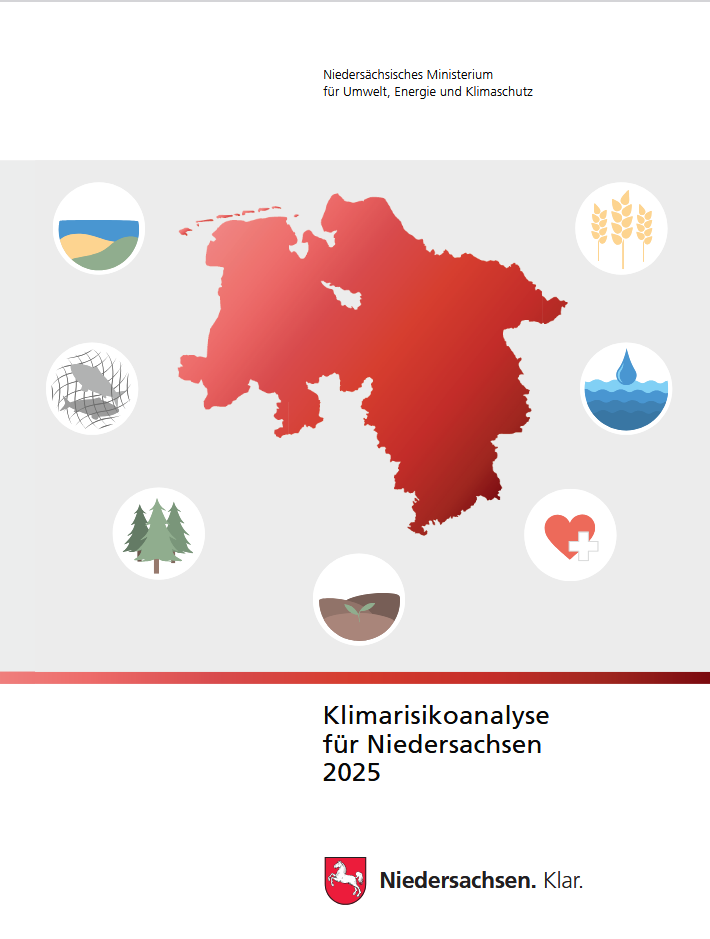
The Lower Saxony Competence Center for Climate Change (NIKO) developed the analysis in collaboration with numerous specialist institutions and experts from research and practice. It considers 42 climate risks in seven key areas of action:
- Soil
- Agriculture
- Fisheries
- Forestry and forest management
- Coastal and marine protection
- Water balance and water management
- Health
The analysis highlights where urgent adaptation measures are needed and which areas are particularly affected. It supplements the Climate Impact Monitoring Report for Lower Saxony 2023 and forms an important technical basis for updating Lower Saxony's strategy for adapting to the consequences of climate change.
The climate risk analysis was developed in collaboration with:
- the State Office for Mining, Energy, and Geology (LBEG)
- the Lower Saxony State Agency for Water Management, Coastal Protection, and Nature Conservation (NLWKN)
- the NLWKN Coastal Research Center (NLWKN-FSK)
- the Lower Saxony State Health Office (NLGA)
- the Lower Saxony Chamber of Agriculture (LWK)
- Kommunale Umwelt-AktioN e. V. (UAN)
- the Northwest German Forest Research Institute (NW-FVA)
and other experts from various disciplines.
The broad institutional participation underscores how complex and interdisciplinary climate adaptation must be considered—and how important cooperation between science, administration, and practice is.
As the center for climate research in Lower Saxony, the ZKfN expressly welcomes this well-founded analysis. It creates transparency about existing risks, supports strategic decisions, and strengthens the scientific basis for effective adaptation measures in the state.
The complete climate risk analysis for Lower Saxony 2025 is available here:

More Posts
All
Forest disturbances and climate shape the diversity of butterflies and moths
First scientific DIVERSA publication
2 min. Reading time

UMEX-HOPE launches with a newsletter and a LinkedIn page
Insights into research, processes and collaboration
1 min. Reading time
Coordination Meeting of the Climate Future Labs in Braunschweig
The exchange focuses on the interfaces between the laboratories
3 min. Reading time